EXERCISE-BASED REHAB

Accelerate Your Recovery with Exercise-Based Rehabilitation

Exercise‑Based Rehabilitation

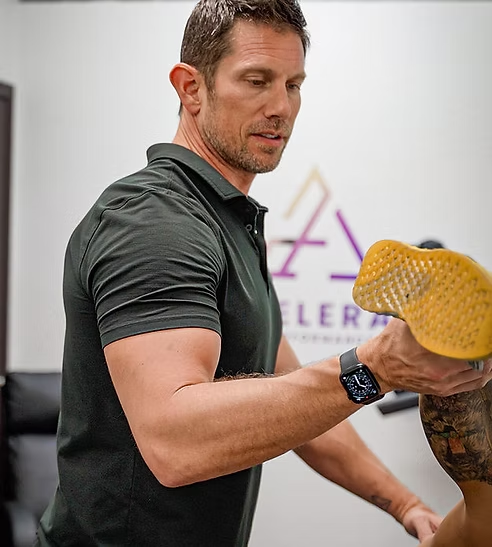
At Accelerate Sport & Spine Rehab, we harness the power of Exercise‑Based Rehabilitation (EBR) to help you recover stronger—whether you’re coming back from a sports injury, acute strain, or chronic condition. EBR isn’t just about movement; it’s a structured, evidence‑backed approach that combines targeted exercise with individualized guidance to rebuild strength, restore function, and reduce the risk of re‑injury.


Dr. Jonas and Dr. Watts are highly skilled practitioners who know the cornerstone of recovery is gaining confidence and strength. That is why we focus on EBR in the clinic to get patients back better than ever.

Why EBR Works

Reduce the risk

Studies consistently show that tailored exercise programs significantly reduce the risk of re-injury after acute injuries, such as ankle sprains. One meta-analysis found a nearly 40% reduced risk of recurrence over one year compared to usual care

Home-based

Home-based, functionally oriented EBR—like the kind offered in our programs—has significantly improved mobility and daily function following hip fractures, even months after traditional rehabilitation ended

For lumbar

For lumbar (lower back) degenerative disc conditions, recent systematic review evidence supports the use of individualized exercise-based interventions, which not only relieve pain but also decrease recurrence and enhance overall quality of life

You+Accelerate Sport and Spine New Braunfels = Winning Team

We craft each EBR plan to meet your unique needs—whether it’s post-surgical recovery, chronic pain management, or reinjury prevention. Our approach fosters safe and sustainable progress, with clear goals, measurable milestones, and expert guidance at every step. You’ll regain confidence, move with purpose, and get back to life—stronger than before.

Here’s a polished, SEO‑optimized (~230‑word) copy for your website AccelerateNB.com, focusing on your use of Low‑Level Laser Therapy (LLLT) for injury rehabilitation. It’s tailored to be reader‑friendly and includes three high‑quality studies for credibility:


Here’s a refined, SEO-optimized version of your website copy (approximately 230 words) featuring clear Exercise-Based Rehabilitation (EBR) messaging, and newly added FAQs based on the five most frequently searched questions online.

Accelerate Your Recovery with Exercise-Based Rehabilitation

At AccelerateNB.com, our Exercise-Based Rehabilitation (EBR) program empowers you to bounce back from injury with strength and confidence. By blending individualized, evidence-based exercises with professional guidance, we help you restore movement, reduce pain, and prevent future setbacks—all in a way that’s easy to understand.


Why Choose EBR?

  • A meta-analysis found that tailored rehab programs cut recurrence of ankle sprains by nearly 40% over one year versus usual care .
  • Targeted home-based EBR significantly improved mobility and daily function in post-hip-fracture patients—months after standard rehab ended .
  • For degenerative low back conditions, individualized exercise-based interventions relieve pain and enhance quality of life .


Our approach is simple: customized plans, measurable progress, and expert support keep you moving steadily toward your recovery goals. Whether you’re rehabbing after surgery, managing chronic pain, or aiming to avoid future injuries, we’ve got your back—literally.

How We Help at AccelerateNB

Exercise-Based Rehabilitation FAQs

Many clients experience initial relief in a few weeks—more meaningful improvements typically occur over several months of consistent EBR (startptnow.com).

EBR is effective for sprains, strains, tendonitis, ligament tears, runner’s knee, tennis elbow, Achilles tendonitis, and other common sports injuries (Advantage Physiotherapy, physiomed.ca).

Some discomfort is normal as you build strength, but any pain or fatigue usually subsides over time under professional guidance (NewYork-Presbyterian).

Sessions involve a complete assessment, hands-on techniques (like manual therapy), mobility exercises, strength work, and education on proper posture and self-care (Revolution Rehab).

Returning safely requires medical clearance, gradual progression, and tracking pain (e.g., with a pain log). Cross-training, strength work, and pacing help prevent setbacks (SELF).